How we use Claude to run Shopify stores for our clients


Most webshops don't lose revenue on the big things. They lose it on the small tasks nobody gets to in time. A customer email that sits for two days. A review that never gets approved. A campaign that never went live because the week filled up.
At PMA we now run most of those tasks through Claude. Not because it's a fun toy, but because it works. Here's how.
What an AI assistant does and doesn't do for you
Claude is an AI assistant you can connect to the tools you already use. Shopify, Gmail, your email platform, Google Drive. Those connections are called connectors. Once they're hooked up, you ask for what you want in plain language and Claude pulls in the right tool itself.
An example. You ask: build a campaign for the end of the month, look at my best-selling product and my best campaign so far, and come back with an idea. You don't mention Shopify. You don't mention your email platform. Claude works out which connections it needs, pulls the data, and hands you a reasoned proposal.
That saves hours. Normally you do that research yourself, build the campaign yourself, go into Shopify for the discounts. Now there's a plan ready before your coffee's gone.
The tasks we put on autopilot
The real difference is in scheduled tasks. Things that run at set times without anyone having to ask. Here are a few we set up for clients.
- Customer service on autopilot. Twice a day Claude reads the inbox, checks the matching order in Shopify, and drafts a reply in Gmail. It understands the context of the thread, not just single messages. You read it over and hit send. That's it.
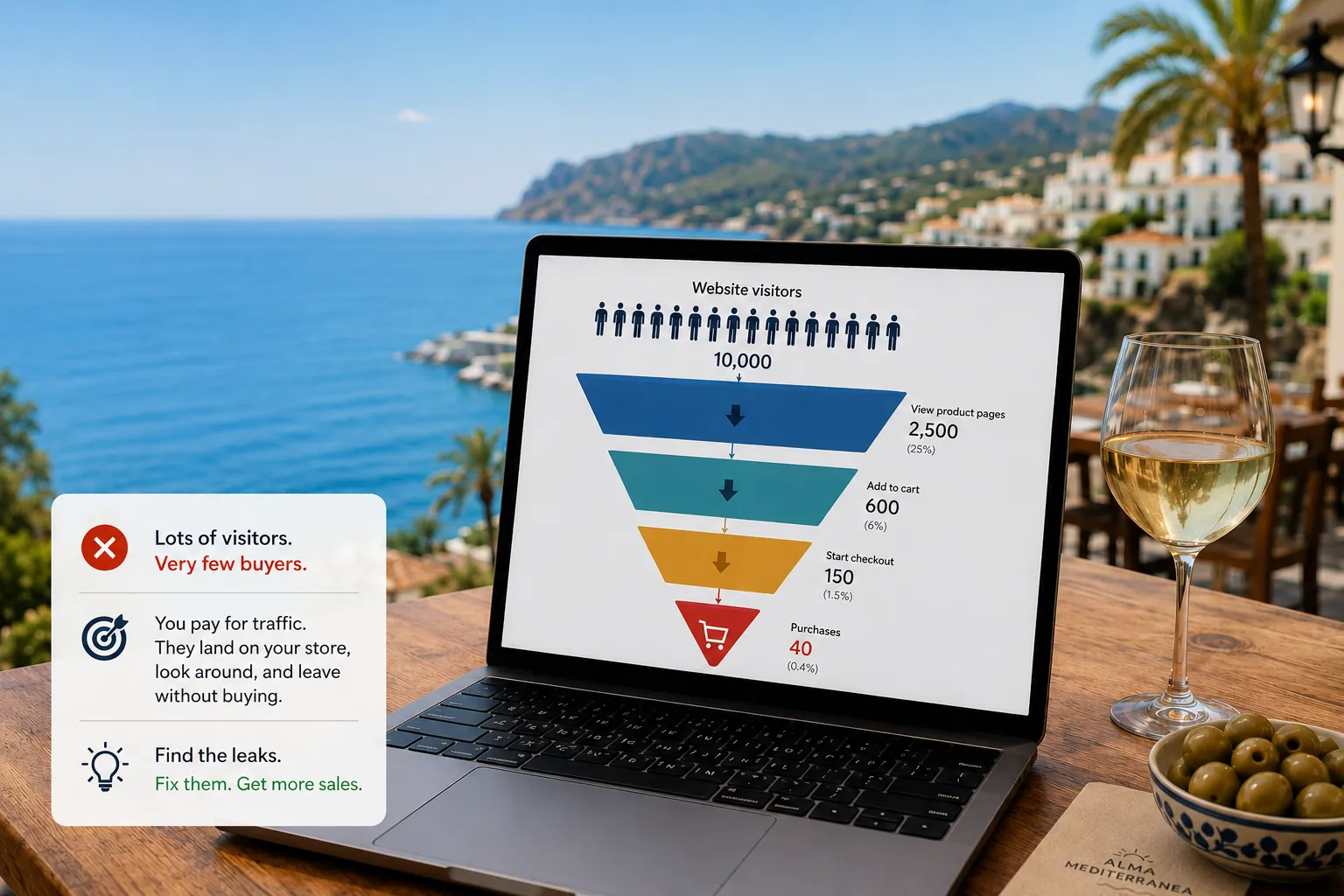
- Weekly conversion review. Claude pulls data from your analytics and from Shopify and points to where visitors get stuck. Dead clicks, spots where people stop scrolling, a checkout step that loses too many. We add our own expertise on top and change the store. The next week, Claude measures whether the change did anything.
- Handling reviews. New reviews get read, approved and answered. On autopilot, but within the limits you set yourself.
- Monday morning report. How much sold, what won, what lost. Not a dashboard you have to dig through, but a short state of play.
- SEO research. Once a month: keyword research, blog ideas, what your competitors are doing, where you rank.
Where the human stays in the loop
This is where a lot of people go wrong. When you connect a tool, you get three choices. Allow everything, ask permission each time, or block. We advise against allow everything. Always.
We've seen too often what happens when you let an AI loose on a store with nobody in between. Things break. Or something goes out the door that should never have left. So we work by the rule we apply in practice: the AI can do about 80 percent, the last 20 percent needs a human. Read what it wants to do. Decide if it's right. Then approve.
That's not a brake on the technology. It's what makes it usable for a real business with real customers.
What this looks like with real clients
Two stores, two very different worlds. The same approach underneath.
Sal y Sol is a Mediterranean fashion boutique in Jávea with a Shopify till in the shop and an online store that serves all of Europe. With a fashion brand the catalogue changes with the season and everything turns on moving fast. Which piece is selling this week, what is running low on stock, where online buyers drop off at checkout. Exactly the kind of questions the weekly data review is built for. Because the shop and the webshop run on one Shopify system, the report ties it all together: not guesswork, but what actually sold, in the shop and online.
Purple Chord sits at the other end of the spectrum. Vintage drums and cymbals, run by Beppe, with restoration, a showroom by appointment, and shipping all over the world. Here trust matters more than volume. Every customer has specific questions, every piece is one of a kind, and the customer service has to be right down to the detail. The inbox triage that checks the order in Shopify and drafts a reply fits well there: the knowledge stays with Beppe, the legwork comes off his plate. Their experience with us lands on the same thing we steer by. Sharp questions up front, everything tied to measurable goals, and staying honest about what works and what doesn't.
What both share: the boring, repetitive work goes to autopilot, the human keeps control over what matters.
Why this matters for you
You don't have to check your inbox three times a day anymore. Your conversion work doesn't stall because the week filled up. Your campaigns start from your own data, not a gut feeling. And most of it happens while you're busy with something else.
At PMA we build this setup into our Shopify clients. We connect the right tools, set up the scheduled tasks, and make sure the human sits at the right point in the process. Not loose experiments, but a way of working that fits how your store actually runs.
Want to know what this could mean for your store? Book a free intro call. We look at your situation, give honest advice, and if we're not the right fit, we'll tell you that too.
Want this running on your store?
We connect the tools, set up the scheduled tasks, and keep a human at the right point in the process.
Book your free marketing audit