Restaurant websites: what actually brings in bookings

Almost every guest checks your website before they book a table, and almost all of them do it on a phone, often while standing outside or sitting on a couch deciding between you and the place around the corner. That moment is where tables are won.
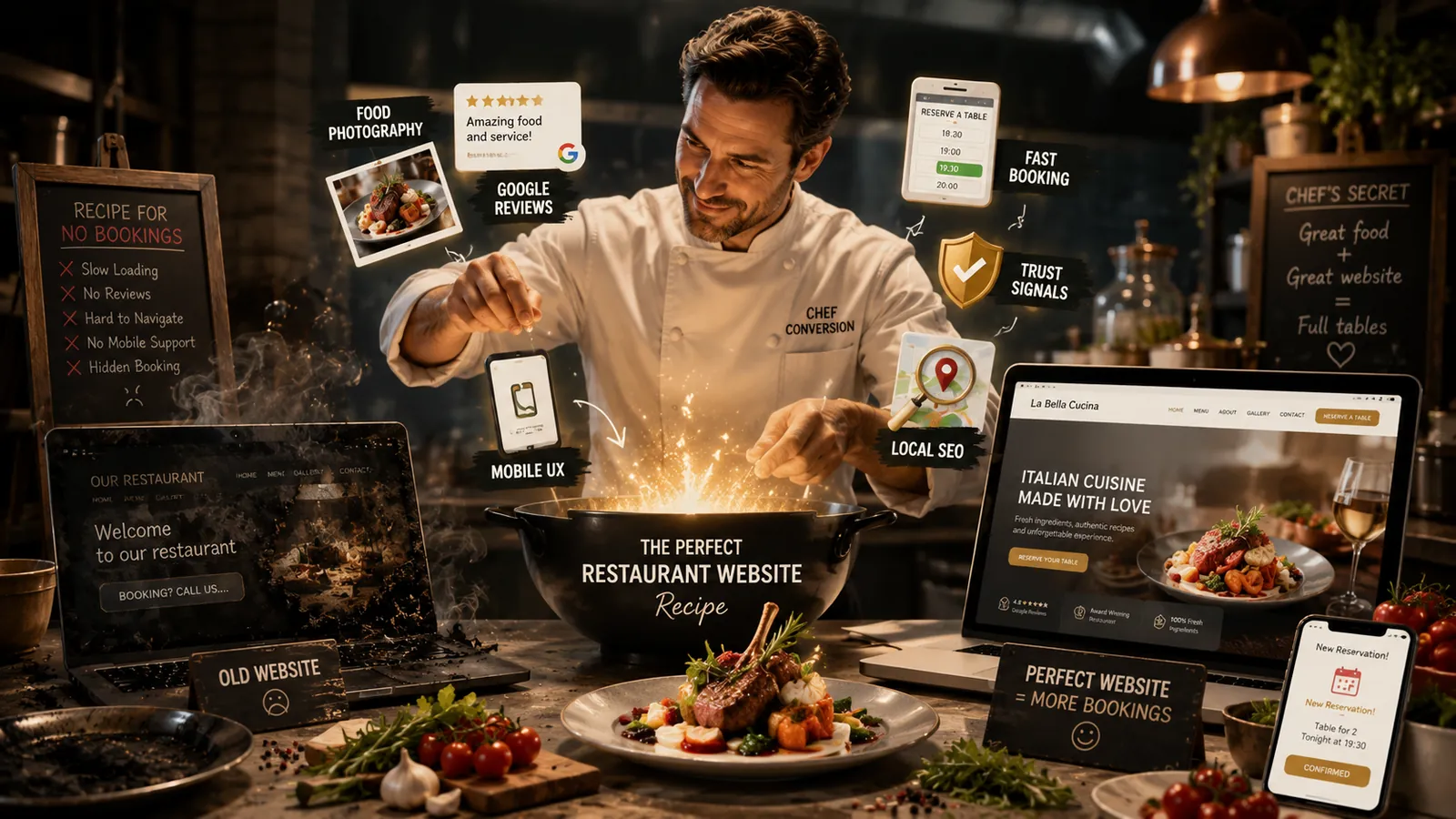
Most restaurant websites lose it. Not because they are ugly, but because they hide the four things a hungry visitor wants, behind sliders, PDFs and "welcome to our restaurant" texts nobody reads. Here is what a restaurant site needs, based on the ones we build.
The four things every guest wants
Someone lands on your site with four questions. What do you serve, what does it cost, when are you open, and how do I get a table. Every one of those answers belongs within one thumb-scroll of arrival.
- The menu, as text on the page. Not a PDF. PDFs load slowly, need pinch-zooming and are invisible to search. A text menu is readable, quick to update and ranks for dishes people search for.
- Hours and address, visible immediately. With a map link that opens navigation in one tap.
- Prices people can see. Hiding them loses more bookings than it wins.
- A booking action that works in two taps. A reservation widget, or at least click-to-call. Never an email form that gets answered tomorrow.
Photos sell the table
Food photography is the single strongest element on a restaurant site. Real photos of your dishes and your room, shot in decent light, beat any stock image and most paragraphs. Guests decide with their eyes; give them something to decide on. If you invest in one thing beyond the basics, invest here.
Built for the phone in the queue
Nearly all restaurant research happens on mobile, so the phone version is not a smaller copy of the site. It is the site. Big tappable buttons for booking and calling, a menu that reads without zooming, and fast loading on mobile data. Every second of load time is a guest deciding the place next door answers faster.
This is the kind of site we build for local businesses: fast one-pagers with everything a guest needs and nothing else. See our web design service, or the Golden Ink case for how a focused one-pager ranks and converts.
Get found by people who are already hungry
Your website and your Google Business Profile work as a pair. The profile wins the map results and shows your reviews; the site convinces and books. Keep hours, address and phone identical in both places, answer reviews, and structure the site around the searches that matter: your cuisine plus your town. That combination is local SEO, and for restaurants it beats every other channel on cost.
Reviews deserve a spot on the site too. A line of real Google review quotes with names does quiet work on doubting guests. You earned them; show them.
Keep it small and alive
A restaurant site does not need ten pages. One good page, or a handful, beats a big site that nobody maintains. What it does need is truth: today's hours, the current menu, this season's photos. An outdated menu online costs trust at the exact moment a guest was ready to book. Choose a setup you can update yourself in minutes.
Where to start
Grab your phone, open your site, and try to book a table. Count the taps and the seconds. If the menu is a PDF, the booking is a contact form, or the site takes ages on mobile data, you know your list. Fixing those three usually costs less than one quiet weekend, and if the foundations are too old to fix, our redesign checklist shows what a clean rebuild looks like. Running ads for your restaurant as well? Make sure the page they land on keeps the promise, per our landing page guide.
Frequently asked questions
Is a PDF menu on my website a problem?
Yes, and it is the most common one we see. PDFs are slow on phones, hard to read without zooming, and Google cannot present them the way it presents page text. Put the menu on the page itself as text. Update it in minutes, readable with one thumb, findable in search.
Does my restaurant need online ordering or reservations on the site?
It needs whatever removes friction for your guests. A busy dinner restaurant benefits most from a reservation widget guests can use in two taps. Takeaway places live on online ordering. At minimum, a click-to-call button that works. What does not work is 'booking? call us' buried on a contact page.
What does a restaurant website cost?
A focused one-pager with menu, photos, hours, map and booking typically sits in the low thousands built professionally, far less than a quiet Tuesday costs you per year. The price depends on photography, ordering integrations and languages. We quote fixed prices after a short call.
Do I need a whole new website or can my current one be fixed?
If the bones are good and it works on a phone, fixing beats rebuilding: menu as text, better photos, a visible booking button. If the site is slow, dated and painful on mobile, a rebuild is usually cheaper than patching. Our redesign checklist covers how to decide.
Thinking about a new site?
We build fast, conversion-focused websites for small businesses, and we rebuild them without losing the rankings you earned.
See our web design service