Landing page design that converts: the rules that hold up


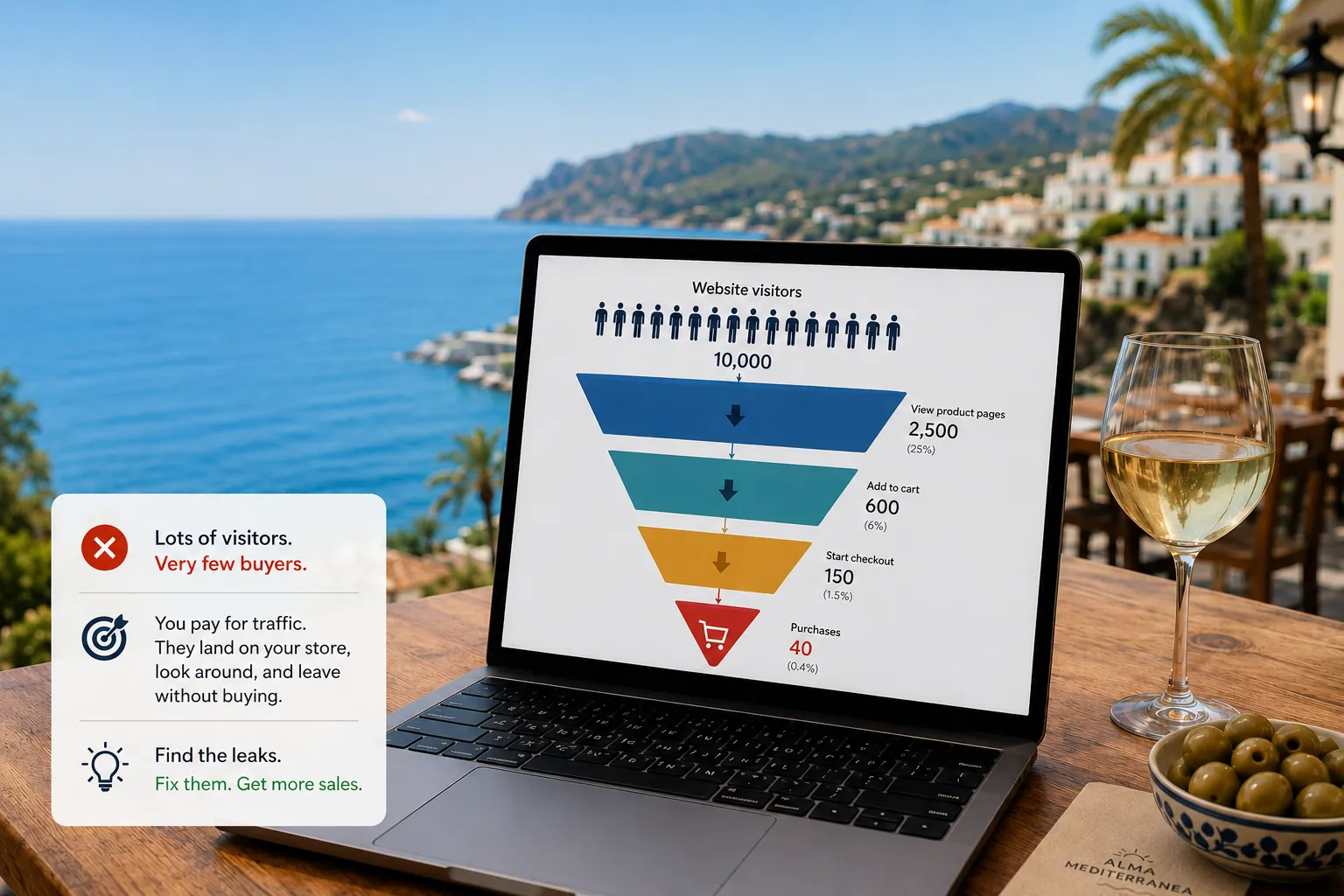
Most ad budgets do not die in the ad platform. They die on the page after the click. The ad promised one thing, the page shows another, the visitor needs four seconds to feel lost, and the back button does the rest.
A landing page fixes that with focus. It is a page with one job, built for one audience, asking for one action. These are the rules that keep holding up, campaign after campaign.
One page, one goal
Decide the single action before anything gets designed: request a quote, book a call, order the product. Then remove everything that competes with it. That includes the navigation menu; a visitor from an ad does not need your whole site, and every extra exit is a leak. One page, one goal, one button repeated down the page.
Match the message to the ad
The click happened because of a promise. The page has to repeat that promise in the first screen, in roughly the same words. Ad says "websites for restaurants", the page opens with websites for restaurants. Not "welcome to our agency". Every step between the promise and the page costs a share of visitors, and this is the cheapest fix in this whole article: it costs nothing but attention.
The first screen decides
Visitors judge before they scroll. The first screen needs a headline with the concrete benefit, one supporting line, and the button. Specific beats clever: a number, an outcome or a timeframe in the headline outperforms wordplay nearly every time. If a stranger cannot say what you offer and what to do next within a few seconds, the page fails regardless of how it looks.
Proof, not promises
Everyone claims quality. Proof looks different: real reviews with names, recognisable client logos, a concrete case with numbers, before-and-after material. Use what you genuinely have, even if modest. Three real reviews from named customers beat a wall of anonymous five-star quotes, and invented numbers are the fastest way to lose the trust the page exists to build.
Ask for less
Every form field costs conversions. Name, email, maybe phone; the rest can wait until you talk. The same goes for choices: one offer converts better than three tiers on a cold click. You can always present options later, in the conversation the page won you.
Landing pages are half the story; what happens after the click is conversion work. We build the pages, wire up the measurement and test them as part of our CRO service.
Speed and mobile are table stakes
Most ad clicks happen on phones, so the page must load fast on mobile data and work with thumbs: readable text, tappable buttons, forms that do not fight autocomplete. Past a few seconds of load time, visitors leave before your headline gets its chance. Compress images, skip the video background, test on a real phone.
Test one thing at a time
Once traffic flows, the page becomes an experiment. Change the headline, or the proof, or the form length. One change, enough visitors, then judge. Change three things at once and you learn nothing, whichever way the number moves. Slow, boring, and it compounds: a page that improves a little every month ends up embarrassing its first version.
Where this fits your campaigns
If you run Meta Ads or Google Ads, each distinct campaign promise deserves its own page. And if your ads point at a webshop instead, the same thinking applies to product pages; our guide on traffic without sales covers those leaks. Rebuilding your site anyway? Plan the campaign pages into the structure from day one, as part of a proper redesign.
Frequently asked questions
What is the difference between a landing page and a homepage?
A homepage serves everyone: new visitors, returning customers, job seekers. A landing page serves one campaign and one action. It matches a specific ad or email, strips away navigation and choices, and asks for exactly one thing. That focus is why it converts better than sending ads to your homepage.
What is a good conversion rate for a landing page?
It varies too much by industry, offer and traffic source for one honest number. Cold social traffic converts far lower than warm search traffic. Watch your own trend instead: measure, change one thing, measure again. A page that improves month over month beats chasing someone else's benchmark.
How many landing pages do I need?
One per distinct campaign or audience. If you run three ad campaigns with three different promises, sending them all to the same page breaks message match for two of them. More relevant pages mean cheaper clicks and more conversions, which is why they pay for the extra work.
Do I need special software to build landing pages?
No. A landing page is just a page with fewer distractions; every platform can produce one. Dedicated tools make testing easier, but the wins come from message match, one clear action and speed, not from the tool that renders the page.
Paying for clicks that do not convert?
We build and test landing pages as part of our conversion work. Same traffic, more customers.
See our CRO service